

Red River Insights - Agentic Commerce top10
From search bars to shopping agents.


Red River Insights - April 2026

Dear friends,
For the past decade, ecommerce has been built around the same ritual: search, scroll, compare, click, checkout. But this interface is starting to crack. Consumers are no longer just searching for products; they are asking AI assistants to make decisions for them. “Find me the best running shoes for knee pain under €150.” “Compare these three baby strollers.” “Reorder my skincare routine, but cheaper.” “Book the supplier that meets our compliance requirements.” The storefront is slowly moving from the website to the agent.
This is the promise, and the threat, of agentic commerce. In a world where AI agents can discover products, compare alternatives, trigger payments, reconcile invoices, and manage returns, the rules of commerce change. Brands no longer compete only for human attention. They compete to be understood, trusted, ranked, and selected by AI systems. The next version of SEO is not about ranking on Google anymore. It is about making product data readable by ChatGPT, Perplexity, Claude, Gemini, and the enterprise procurement agents sitting inside large companies.
The implications are significant. When agents become the new interface between buyers and sellers, then every layer of the commerce stack needs to be rebuilt (or at least optimised): product data, catalogue access, conversational sales, payments, identity, billing, procurement, and post-purchase resolution. The first wave of agentic commerce will not necessarily look like a consumer asking an AI to buy sneakers. It may start in less visible places: a procurement team automating supplier selection, a Shopify merchant converting customer calls through an AI voice agent, or a marketplace routing payments and reconciliation through a unified API.
This is why this month, we’re spotlighting the 10 most promising European startups building the infrastructure for agentic commerce.
As always, we choose the themes that intrigue us, but the ranking itself is produced by RAMP's Growth Score (momentum and leading indicators), the companies are picked by the algorithm, not by us.
But first, big news in our portfolio !
Some months are special: this one brings both a new investment and a new exit.

We are very proud to announce our investment in Sans Strings Studio, leading their $5.5m Seed Round alongside a16z speedrun.
Founded by Sébastien Deguy and Ryan Corniel, Sans Strings Studio is building a new kind of tech-enabled animation studio, combining proprietary real-time “digital puppetry” technology with original IP creation. At the core of the company is F.E.L.T., a real-time character performance system that allows artists to bring animated characters to life instantly, with emotional expressiveness, creative control, and minimal latency.
What convinced us was the rare combination of an exceptional founding team, a powerful proprietary technology asset, and a market that is structurally ready for new production models. Sébastien previously founded Allegorithmic, the company behind Substance, a global standard in 3D creation acquired by Adobe, while Ryan has spent years building and refining the real-time performance systems now being productized by Sans Strings.
We believe Sans Strings is exceptionally well positioned to redefine how animated content is created, performed, and scaled across series, games, live experiences, and interactive media.
A huge congratulations to Sébastien, Ryan, and the entire Sans Strings Studio team. We are very excited to support them on this next chapter. If you want to learn more.

We are incredibly proud to have backed WeMaintain since 2021 and to see the company join forces with Otis, one of the global leaders in elevators and smart building infrastructure.
Founded by Jade Francine and Benoît Dupont, WeMaintain has built a modern, tech-enabled model for elevator installation and maintenance, combining software, data, and best-in-class field operations. Since our investment, the company has scaled internationally across France, the UK, Singapore, and Hong Kong, won major enterprise customers, and proven that a new generation of industrial services companies can emerge from Europe.
This acquisition by a US-listed global leader is a strong validation of WeMaintain’s vision, execution, and market impact. More importantly, it opens a new chapter for the team, who will remain independent and continue to lead the company’s development.
A huge congratulations to Jade, Benoît and the entire WeMaintain team!
RAMP's Agentic Commerce top10
We hope this sparks interesting conversations. If you have any comments or would like to suggest a startup that should be included, feel free to reach out to us. Joseph, Chloé and Olivier will be delighted to discuss these trends and rankings.
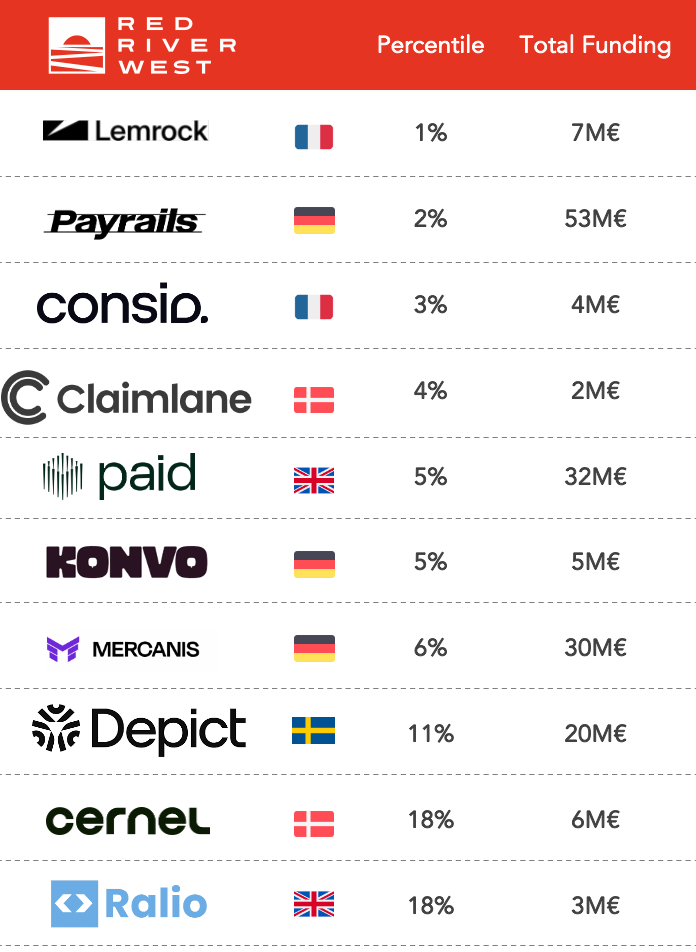
(Ranking established on 24/04/2026)
We’ve highlighted 5 key trends illustrated by these companies:
1. Product data is becoming the new SEO layer.
The first bottleneck of agentic commerce is not checkout. It is visibility. But an AI agent doesn’t read a website like a human. If AI agents become the first point of discovery, merchants need their products to be understandable by machines, not just appealing to humans. That means clean attributes, structured catalogues, real-time prices, accurate availability, normalized descriptions, return policies, delivery information, and enough context for an AI system to compare products reliably. Cernel is building exactly this layer, turning fragmented product data into AI-ready commerce assets. Lemrock goes one step further by connecting merchant catalogues directly to LLM interfaces, making products discoverable and potentially purchasable through environments like ChatGPT, Claude or Perplexity. The common thread is clear: in agentic commerce, bad product data becomes invisibility. The merchants that win will be the ones whose products agents can retrieve, understand, compare, and trust.
2. Conversational commerce is shifting from support to sales.
The first generation of ecommerce chatbots answered FAQs, tracked orders, and escalated tickets. The new generation is more ambitious: it recommends products, qualifies intent, handles objections, resolves issues, and pushes the customer toward conversion. Konvo AI embodies this shift with proactive ecommerce agents that combine support, product recommendation and issue resolution directly on merchant websites. Consio AI takes the same logic into voice, building AI sales agents that handle inbound calls, understand customer needs, recommend products and help close transactions. This matters because many high-intent purchases still happen through conversation, especially when the product is complex, expensive, or requires reassurance. In agentic commerce, the sales assistant does not disappear; it becomes software, always available, always trained, and increasingly capable of turning intent into revenue.
3. Payments, trust and billing are the hidden bottlenecks.
It is easy to imagine an AI agent buying on behalf of a user. It is much harder to make that transaction safe, authorized, auditable and economically viable. Before money moves, the agent needs clear permission: who authorized the purchase, within which limits, and under which conditions? This is where Ralio comes in, building the trust infrastructure for agent-triggered payments through guardrails, identity verification and audit trails. Once the transaction is approved, platforms still need to route and reconcile payments across complex payment stacks, which is where Payrails focuses with payment orchestration across multiple PSPs. And after agents start doing real work for businesses, another question emerges: how do the companies building those agents price, meter, invoice and prove the value of that work? Paid addresses this monetization layer, helping AI agent companies track usage, outcomes and underlying AI costs so they can bill customers sustainably. Together, these companies show that agentic commerce is not just a new interface. It requires new financial rails underneath: trust before the transaction, payment orchestration during the transaction, and billing infrastructure after the agent has delivered value.
4. B2B procurement may be the first scaled version of agentic commerce.
Consumer shopping agents still face major adoption barriers: trust, taste, UX, payments and liability. B2B procurement is different. It already runs on structured workflows, approval rules, supplier data, budgets, compliance checks and measurable ROI. That makes it one of the most credible early markets for agentic commerce. Mercanis is building specialized AI agents across the procurement cycle, from sourcing and supplier management to contracts, catalogues and compliance. Procure AI follows a similar logic, automating sourcing, contracting, purchasing and invoice-related workflows. This is agentic commerce from the buyer side: not a personal assistant looking for shoes, but an enterprise operating layer that helps companies buy faster, cheaper and with more control. The enterprise version of agentic commerce may not look like shopping at all. It may look like procurement.
5. Post-purchase will become agentic too.
Agentic commerce does not stop at the moment of purchase. If an agent buys a product, another agent will need to manage what happens when the delivery is late, the product is defective, the customer wants an exchange, or the warranty claim needs to be processed. This is where Claimlane becomes highly relevant. By automating returns, claims and complex post-purchase workflows for brands and retailers, the company addresses a less visible but critical part of the commerce lifecycle. This layer will matter more as transaction volumes become increasingly agent-mediated. Consumers and enterprises will only delegate more purchasing decisions if the entire lifecycle can be trusted, including when something goes wrong. In other words, the future of agentic commerce will not be won only at checkout, but also in the resolution layer after the sale.
More on RAMP's scoring method
The ranking of these startups is based on the estimated momentum of the company, but the algorithm does not assess the quality or reliability of the products/solutions developed by these companies!
Find out about the algorithm behind this ranking and the way scores are calculated here: Cheat sheet on RAMP
In case you missed them, our latest top 10s are here: AI’s Picks and Shovels (March26), AI safety & governance (February26), Energy (January26), Nature & Biodiversity (December25), Digital Biology (November25), ( Women-founded startups (october25), Industry autonomy (September25) Advanced Materials (July25), Quantum (June25)
All the previous Top 10 are here.
Portfolio news:
Le Collectionist was featured in The Times through journalist Susan d’Arcy, who experienced a fully personalized wellness stay at Villa Ema in Villefranche-sur-Mer, covering the brand’s bespoke concierge model.
Worldia continues its international expansion, with US travel agents moving from demos to live bookings on the platform and Canadian agents reporting they can build complex trips in under 10 minutes. The team also closed a new partnership with Lynn Elmhirst’s network, reinforcing its North American push.
Jiko presented alongside Kyriba and Voltava at KyribaLIVE on how In-House Banking powered by T-bills is redefining cash management for corporate treasury teams.
Ada Health announced that the European Patent Office granted its patent on the clinical layer that makes LLMs safe for use in healthcare, a significant IP milestone positioning Ada at the frontier of regulated AI in medicine.
Otera made trend.’s Top 100 Startups ranking for the second consecutive year, this time recording the largest single jump in the entire list at +44 places.
Veesion co-founder Thibault David appeared on BFM Business to discuss how AI is transforming retail theft prevention.
You received this newsletter because we met or worked together and we thought you might be interested in an update, if we got it wrong, feel free to unsubscribe with the link at the end!