


Red River Insights - July 2026
Dear friends,
By 2035, the world could be missing one tonne of primary copper for every four it needs. That is the IEA’s base-case gap between demand and supply from existing and announced projects. Copper is the wiring of the modern economy: it carries electricity through grids, data centres, factories and vehicles.
Critical materials are not necessarily rare. They matter to the economy, are hard to replace and are vulnerable to supply disruption. They sit inside almost everything Europe wants to build: rare-earth magnets in turbines and motors, gallium and germanium in chips and fibre networks, and lithium and nickel in batteries.
The pressure is coming from several directions at once. Electrification remains the largest driver: the energy sector accounted for around 75% of growth in demand for key energy minerals in 2025. AI and defence add another layer. Intelligence has a bill of materials too.
But closing the gap cannot mean reproducing the highest-impact version of mining at any cost. The harder question is whether we can secure more material with less land disturbance, less unnecessary drilling, lower-carbon processing and far more recovery from products already in circulation. Lithosquare uses geological AI to focus exploration before capital and drilling are committed. Hades Mining is testing a way to reach deep deposits without an open pit. Seven of this month’s ten companies focus on recovery, recycling or secondary-material markets.
The weak point is not only the mine. China refines more than 90% of global gallium, graphite, manganese and rare earths. A 2026 EU audit found that 10 of the 26 critical materials needed for the energy transition are fully imported and that none of the rare earths used in the EU are processed domestically. Europe therefore needs options across the whole chain: better ways to find deposits, lower-impact extraction, local processing, recovery that ends in usable industrial material and markets that buyers can trust.
The policy goal is clear. By 2030, EU benchmarks call for at least 10% of annual consumption to be extracted in Europe, 40% processed here and 25% supplied through recycling, with no more than 65% coming from a single third country. The distance from today’s position is large. It is also where a new generation of companies is emerging.
This Top 10 follows that chain from discovery to extraction, recovery, manufacturing and trade, with one question in mind: can Europe close its material gaps without outsourcing the environmental cost?
Introducing RiverOS:
For seven years, RAMP was Red River West’s information layer: proprietary data and algorithms that collect, structure and connect what we know about European technology companies. Agentic AI has changed what that foundation can do. On top of the information layer, we built a powerful action layer: agents that use the same context to research companies, find trends and move work through the investment process. The data helps us see; the agents help us act.
Together, those two layers have turned our internal data platform into an operating system for investing. The name had to evolve with it. What used to be called RAMP is now RiverOS.
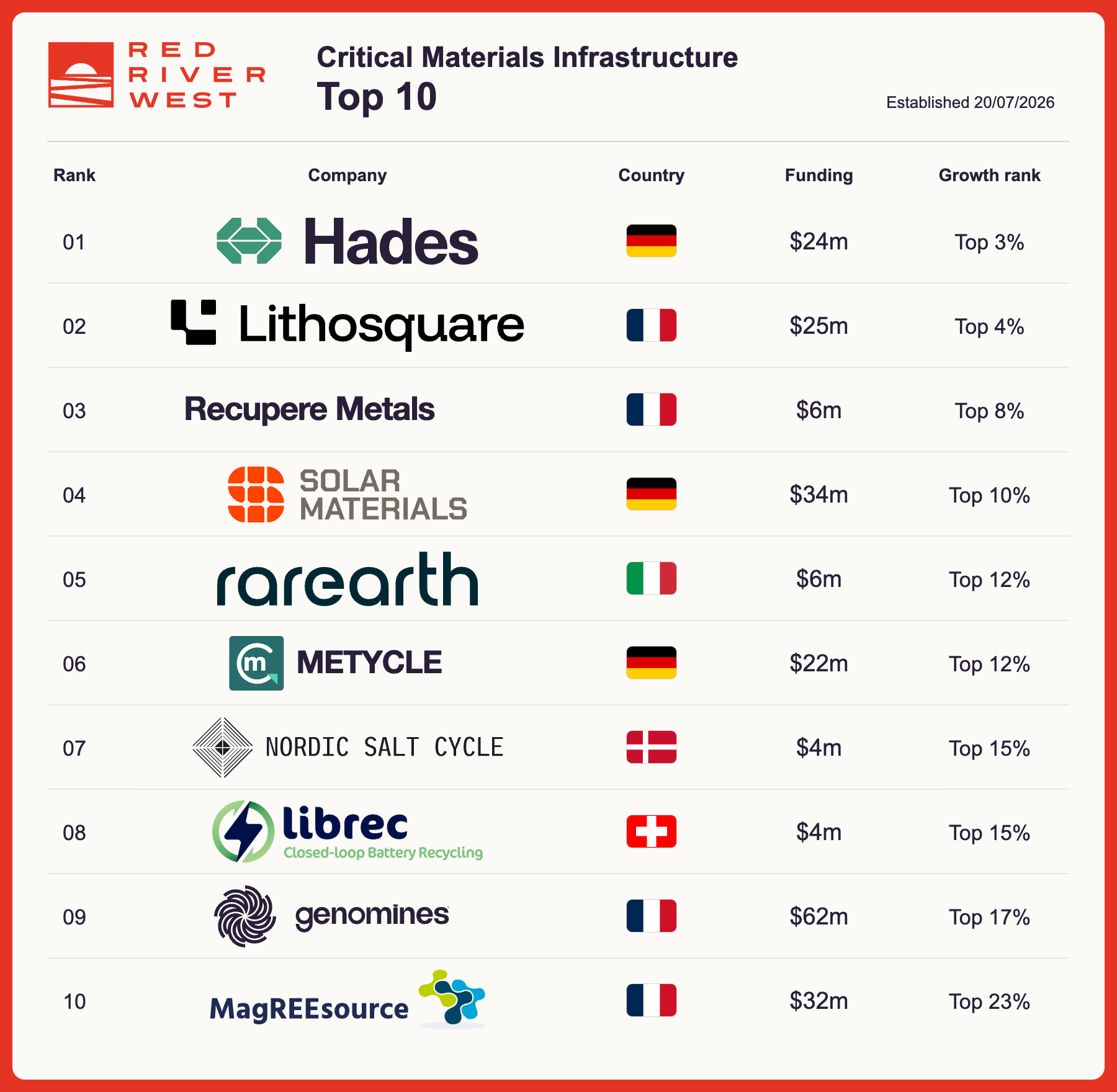
The ten companies span five countries, with an average growth percentile of 89% and median recorded funding of $23m.
1. The mine itself is being redesigned around a smaller footprint
Traditional exploration and extraction can mean years of drilling, large surface works, water use and energy consumption. The first shift is not mining without impact. It is using more information before disturbing the ground, then trying to reduce the surface footprint of extraction.
Lithosquare builds geological AI around how mineral deposits actually form, rather than looking only for patterns in past data. In June, Eramet, Lithosquare and the BRGM signed a framework partnership after an initial exploration programme that the partners say validated the approach. They plan to combine historical records, new field measurements and geological AI across prospective areas in Africa. Better targeting should mean fewer unnecessary field campaigns and drill holes, although that benefit still has to be demonstrated across projects.
Hades Mining is developing laser drilling and fluid-based recovery to reach deep mineral deposits without digging an open pit. It is still being tested in the lab, with field trials ahead. Genomines changes what can count as a resource by engineering plants that pull nickel from low-grade soils.
The three companies are redesigning different decisions: where to look, how to reach a deposit and what can become an economically useful source of metal. The sustainability promise is meaningful, but repeatable field performance, lower impact per tonne and industrial economics remain unproven.
2. Recovery is becoming selective and modular
A material can be present in a used battery and still be inaccessible. The hard part is separating valuable products from black mass, the mixed powder left after batteries are shredded, at a cost and footprint that can compete with newly mined material. Responsibility here means recovering more of what is already above ground without creating another energy-intensive or polluting process.
Nordic Salt Cycle uses heated salts to separate useful materials from mixed or damaged battery waste. Its modular approach is designed to produce usable nickel, cobalt and lithium products in smaller European plants.
LIBREC takes the other route: an operating local facility that discharges, dismantles and mechanically processes batteries before recovering the materials. Porsche says LIBREC’s Swiss plant can handle up to 9,000 tonnes a year and recover more than 97% of valuable raw materials at full capacity.
The two companies show different ways to decentralise recovery: make the chemistry smaller and more tolerant, or make the industrial loop local and operational.
3. Recycling must end in a usable industrial product
Collecting waste is not the same as securing supply. The recovered material has to meet the next buyer’s specification.
Recupere Metals says it can turn recycled copper scrap directly into electrical-grade wire without mining or smelting, the high-temperature furnace step normally used to extract or refine metal. SOLAR MATERIALS operates a 14,000-tonne solar-module recycling plant that recovers silver, silicon, glass, aluminium and copper. RarEarth recovers neodymium magnets from motors and electronics.
MagREEsource turns recycled material into new rare-earth magnets for wind, mobility and defence applications. Its site in Noyarey, France, has been producing since December 2024 and targets 80 tonnes a year. Its planned MagFactory is designed for 1,000 tonnes a year from 2028 and has been designated a European Strategic Project. The company reports a 91% lower carbon footprint than magnets made from material mined in China.
The sequence matters: secure the waste, recover the metal, make the component, prove that it meets customer standards, then scale. The important word is not recycled. It is usable.
4. Recycled metals need a market
Physical supply is only useful if a buyer can find it, trust it and move it.
Think of METYCLE as a B2B Back Market for secondary metals, except the products are industrial loads rather than phones. The company combines a marketplace with quality checks, logistics, customs and payment. It may look less technological than a new separation process, but it addresses a real bottleneck. Recycled markets stay small when quality, ownership and origin cannot travel with the product.
Better information does not create one extra kilogram of copper or neodymium. It can make the existing supply easier to trust and trade.
Open questions
Can new extraction technologies move from a working process to reliable industrial output? Hades and Genomines still have to prove repeatable economics at scale.
Can recycled material win on cost, not only carbon? If recovered inputs remain more expensive than mined supply, regulation, procurement commitments or consumer pressure may be needed to create the first market. Which mechanism is durable?
Can recovery companies secure enough consistent waste before incumbents do? Chemistry matters, but collection, dismantling and long-term supply agreements will decide whether their plants stay full.
Will European policy create customers or only projects? Grants can build demonstration plants. Repeat orders from automotive, defence, grid and electronics buyers create industries.
Reach out if you have an opinion, or to suggest a company we may have missed.
More on RiverOS
The ranking of these startups is based on estimated company momentum, but the algorithm does not assess the quality or reliability of the products and solutions developed by these companies.
RiverOS’s Score identifies the companies showing the strongest momentum. Red River West then applies a theme-fit and company-status check.
Find out about the algorithm behind this ranking and the way scores are calculated here: RiverOS.
Portfolio news
The Exploration Company opened a Houston Rapid Innovation Lab around a full-scale Nyx crew-capsule mockup and launched TEC Federal to serve the US government.
Otera was named an Enterprise Innovator in HFS Research's 2026 assessment of agentic technology providers, with production deployments at CED and Saab highlighted in the announcement
ZML released ZML/LLMD, an inference server running Llama, Gemma, Qwen and Mistral across NVIDIA, AMD, Google TPU, Intel and Apple hardware.
Resilience Care partnered with Institut Paoli-Calmettes to make remote monitoring part of its oncology care pathways.
Veesion joined UNFI’s July selling show in Las Vegas, presenting its AI-based theft detection to US grocery retailers using their existing security cameras.
You received this newsletter because we met or worked together and thought you might be interested in an update. If we got it wrong, feel free to unsubscribe with the link at the end.